Basic HTML Version


19
CANOLA DIGEST SEPTEMBER 2011
NEW STUDY COMPARES OPENERS AND IMPACTS OF SPEED
Based on the results of the Agriculture and Agri-Food Canada (AAFC)
Lacombe-based seeding speed and depth study, researchers have launched
a new study to focus on a wide range of openers and seeding speeds.
“The previous study worked with a one centimetre knife opener drill, so we
wanted to expand that work to determine if speed was as important with lower
disturbance openers,” explains Dr. Bob Blackshaw, Research Scientist with
AAFC at Lethbridge, Alberta. “We are conducting both small plot replicated
trials and on-farm strip trials at five locations in western Canada across
different soil types.”
At each small plot location, seven different openers are being tested, three low
disturbance, two medium disturbance, two high disturbance and two ground
speeds, four and six miles per hour. “We are partnering with Mike Bevans and
Blaine Metzger of the AgTech Centre in Lethbridge to conduct the trials,” says
Blackshaw. “The AgTech Centre has developed a tool bar that allows us to use
the same seed drill for everything, but with different openers. That minimizes
the confounding effects of using different drills, and makes the openers the
only equipment variable.”
“For the farm-scale research component, farmers will be using their own drill
and three different speeds if possible on one of their fields,” says Blackshaw.
“We have also asked them to do a side-by-side strip trial if they have two
different drills on the farm or can partner with a neighbour with a different drill.
Researchers will conduct canola emergence counts, and where possible,
yield measurements at harvest.”
This is a two-year study, so results will be available after the 2012 crop year.
This study is funded by the Canola/Flax Science Cluster, which is part of the
Canadian Agri-Science Clusters Initiative of AAFC. Industry funding for the
canola portion of the Science Cluster is derived from CCC’s core funds, and
additional project funding is provided by SaskCanola, Manitoba Canola
Growers Association and Alberta Canola Producers Commission.
s
and I target five pounds per acre.
If only 60 percent of the seed is going
to germinate, then you are basically
starting at three pounds per acre,
which doesn’t leave any room for error
for bugs or frost or any other factors.”
Sarafinchan also checks seeding
depth regularly, seeds early and uses
a relatively high well-balanced fertility
program to maximize yield. “This year
I had to spray for f lea beetles as well.
In the end it is a number of things that
make seedling survival a success.”
Recently, researchers at Agriculture
and Agri-Food Canada (AAFC) found
that canola seedling emergence was
generally 50 percent or less, even when
using certified seed with over 90 percent
germination. “These results were a
surprise to us, so we decided to take
a closer look at what was going on,”
explains Dr. Neil Harker, Research
Scientist with AAFC at Lacombe, Alberta.
“In the end it is a number
of things that make seedling
survival a success.”
– Sarafinchan
“We initiated a four-location western
Canada study that compared three
factors: open pollinated versus hybrid
varieties, two seeding depths of one
centimetre (0.5") and four centimetres
(1.5"), and two seeding speeds of four
and seven miles per hour,” says Harker.
The study used a Conservapak seeder
with one centimetre knife openers.
Funding for the study was initially by
the Prairie Canola Agronomic Research
Program and was completed under the
Canola/Flax Science Cluster. Coordi-
nated by the CCC, the science cluster
is funded by industry and the federal
government.
Research results confirmed that
seeding depth was the biggest factor
inf luencing emergence, and shallower
was better. “Although farmers think they
are achieving a half inch depth, often
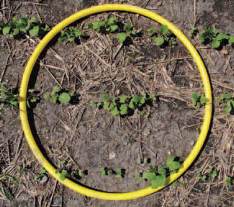
Stands of 10 plants per
square foot (100 per
square metre) are ideal
as they provide a cushion
for loss due to frost,
diseases or insects.
To determine plant
stand per square metre,
use a hoop equivalent
to one-quarter of a
square metre, count
the number of plants
inside and multiply
by 4. Several counts
per field are required
to get a good average.
continued on page 20