Basic HTML Version


9
CANOLA DIGEST SEPTEMBER 2011
canola was $8 per bushel. Now canola
is $12 to $13 per bushel, which means
you’ve got $120,000 out there at risk.”
The risk is that moisture can get into
the bag or that you won’t be able to get to
the canola when you need to unload it.
“The key to storing canola in a bag is to
monitor the grain very closely and be
prepared to move it at the first sign of
trouble,” Stonehouse says.
Digvir Jayas, a grain storage specialist
in Biosystems Engineering and vice-
president of research at the University
of Manitoba, leads a two-year Canola
Council of Canada (CCC) funded study
into the feasibility of bag storage
for canola under Prairie conditions.
In year one, canola went into bags in
the fall at three moisture levels: eight,
10 and 14 percent.
With canola at eight percent moisture,
Jayas did not detect any deterioration
in quality after nine months in the bag.
Canola at 10 percent moisture also seems
safe, he says, but at that level, he would
only store canola in bags for a limited
time. Jayas did see “lots of mould and
hot spots” at 14 percent moisture.
“That moisture content is certainly too
high for safe storage of canola in bags
for any period of time,” he says. This
research will provide clearer insight and
a better understanding of the fit of bag
storage for canola.
BENEFIT VERSUS RISK
Grain storage bags can work well if
managed correctly. Bags can greatly
reduce hauling time from the combine,
especially when time is tight – which it
always seems to be at harvest. In years
with surplus production, bags are a quick
solution compared to the time and
cost of putting up extra bins. The bag
loader and unloader, which are two
separate machines, cost about $80,000.
The 8,000- to 12,000-bushel bags are
$600 to $800 each.
If hot spots are detected in bags, the
best way to manage the situation is
to empty the grain and transfer it to
another bag or bin. Canola should be
aerated after harvest to cool the mass
and, if necessary, remove moisture.
Even though “dry” is 10 percent, canola
should be at eight percent moisture and
cooler than the outside air for safe long-
term storage. Bags can be probed for
moisture and temperature, but may not
be easily emptied (think winter snow
or soft fields) if trouble should start.
Even though Hounjet has the bags and
has had a positive experience storing
canola in them, he does not intend to put
canola in bags unless the alternatives
are worse. If you are going to use them,
he says, just make sure you probe
regularly and make sure you can access
them with truck and unloader any
month of the year.
s
Jay Whetter is communications manager
with the Canola Council of Canada.
Bags are at risk of animal and bird damage, which should be patched to prevent serious water damage and further tearing.
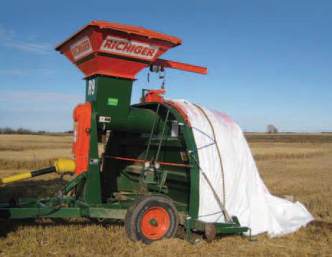
Grain bags cost $600 to $800 each, but they require a loading machine (shown above)
and an unloader.
PHOTO (bottom) Tom Boyle, Saskatchewan Ministry of Agriculture