


 7 / 8
7 / 8


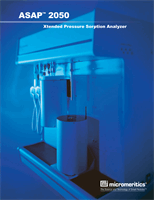
The ASAP 2050 model includes:
• Repetitive Isotherm Cycling
• DFT (Density Functional Theory)
• Single- and Multipoint BET (Brunauer,
Emmett, and Teller) surface area
• Langmuir surface area
• Temkin and Freundlich isotherm analyses
• Pore volume and pore area distributions
in the mesopore and macropore ranges
by the BJH (Barrett, Joyner, and Halenda)
Hydrogen isotherms at several temperatures are rapidly measured using the
ASAP 2050.
The Pressure Composition Isotherm of lanthanum nickel
demonstrates the ability to characterize hydride forma-
tion using the ASAP 2050.
High-resolution nitrogen and oxygen isotherms for
pressure swing adsorption applications are easily
obtained using the ASAP 2050.
method using a variety of thickness
equations including user-defined, standard
isotherm
• Pore volume and total pore volume in a
user-defined pore size range
• F-Ratio plots that illustrate the difference
between theoretical and experimental
isotherm data
• Heat of Adsorption