



 5 / 60

C
ontinuing from last month’s feature
where I outlined the numerous ben-
efits of cycling, I am now turning my
attention to table tennis.
Table tennis, or ping pong as it’s often called,
is the third most numerous participation sport
in the world, after soccer and cricket, and is
played by 2.4m people in the UK.
It is also the most popular indoor sport in the
world, with 222 associations from countries all
around the world affiliated to the International
Table Tennis Federation.
Ping-pong was invented on the dining tables of
England in the 1880s and was originally called
wiff-waff.
The US author and celebrated wit James
Thurber pointed out that ping-pong backwards,
gnop-gnip, sounds much more like a game of
table tennis.
My route to semi-serious table tennis started in
the late 1970s, playing a few games for the
Berkshire Juniors team.
After a break of around 35 years, in 2013, I
started playing in the Newbury table tennis
league.
In an attempt to improve my skills,
from November this
year, I also
play in the
Basingstoke league
in addition to the
Newbury league.
The Newbury and
District Table Tennis
League continues to
thrive with around 150
people playing for 30
separate teams in three
divisions.
To find out more visit
www.tabletennis365.com/newburyThe Newbury league has a wide
geographical coverage, with teams from
Ashford Hill, AWE Aldermaston, Inkpen,
Kintbury, Newbury, Thatcham, Upton, near
Didcot, West Ilsley and Woolton Hill.
They organise an annual handicap tournament,
the Pembroke Cup, and the team I play for,
the Woolton Hill Wombats, won it in 2013-14
and were also the losing finalists in 2014-15.
At the time of writing, late December 2016, the
Wombats have managed to progress to the
quarter final stage of this year’s competition –
so fingers crossed.
A personal highlight from the 2015-16 season
was managing to narrowly beat a lady player
ranked in the top 100 in the UK, in a league
match – not very chivalrous maybe, but a
victory of which I am rather proud.
Unfortunately, the same match this year was
tied at one game all, and 13 all in the third
game, when I had to concede due to injury –
perhaps I had over-exerted myself.
Playing regular table tennis has many benefits,
including improving hand-eye co-ordination,
reflexes and balance. It also helps develop
mental acuity and stimulates different parts of
the brain.
However, playing table tennis doesn’t have to
be competitive or serious and there are many
non-league venues offering an opportunity to
play, often for free.
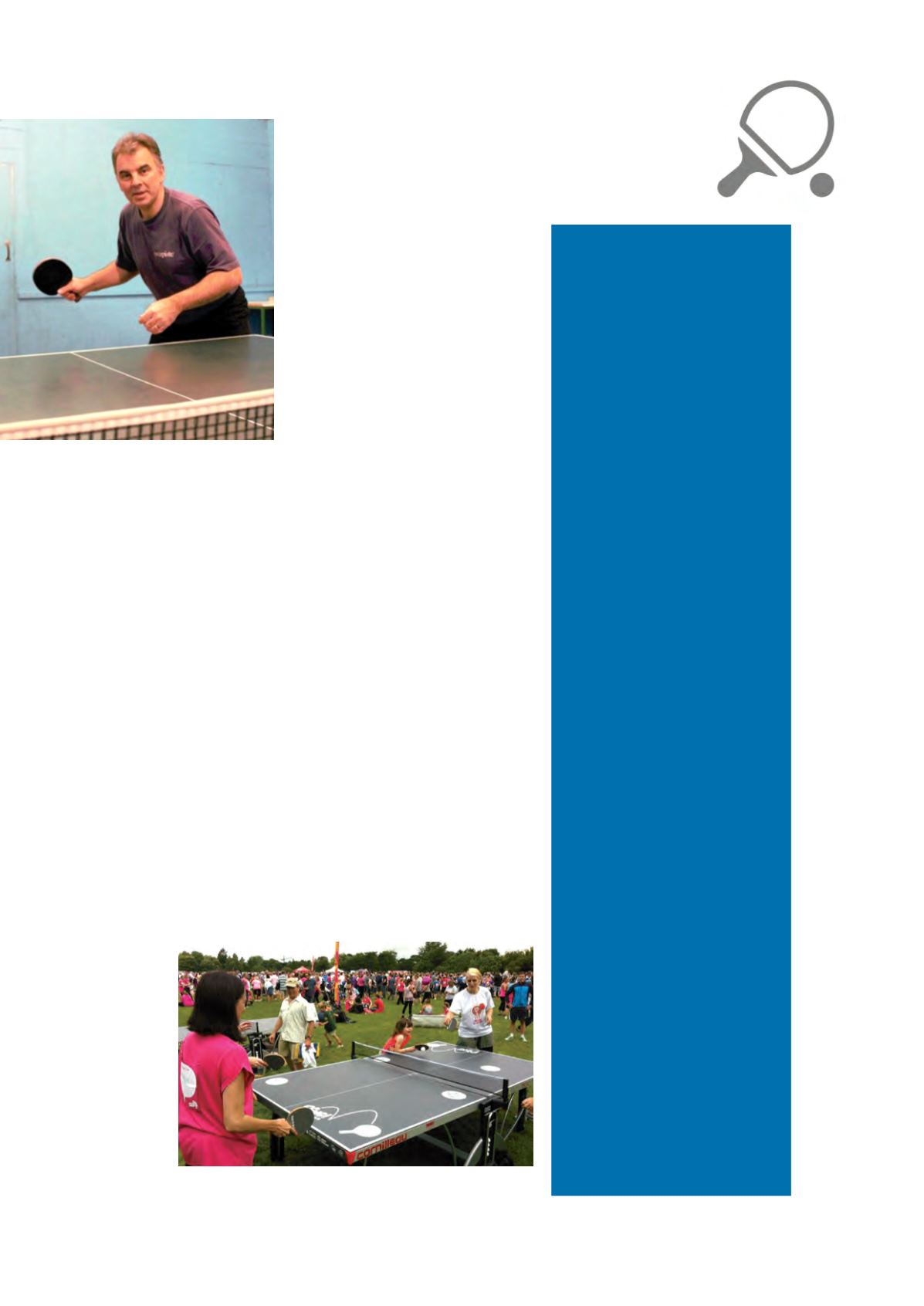
Ping England is a free street ping pong festival
that sees table tennis tables popping up in
remarkable and surprising places, in 21 towns
and cities all over England, during the summer.
To find out more about the festival and where
the nearest pop-up table will appear, visit
www.pingengland.co.ukIf you don’t already play ping pong, why not
pick up a table tennis bat and give it a try?
5
Did you know?
n
Table tennis was banned in
the Soviet Union from around
1930 to 1950. The sport was
believed to be harmful to the
eyes.
n
Table tennis became an
Olympic sport in the 1988
Summer Olympics in Seoul.
n
Early table tennis
paddles were normally made
of cork, cardboard, or wood,
and covered with cloth, leather
or sandpaper.
n
Table tennis balls aren’t
really hollow. They are
pressurised slightly with a gas.
n
A modern table tennis
match at the elite level lasts on
average about 30 minutes. Top
players often smash the ball at
speeds exceeding 100 miles
per hour.
n
How many balls can two
players hit back and forth in 60
seconds? The current record
is 173, set by Jackie Bellinger
and Lisa Lomas in 1993.
n
A modern table is nine feet
long, five feet wide, and 2.5
feet high. The net is six inches
high.
n
China, Sweden and South
Korea are currently the world
powers in table tennis.
Participants at Ping Oxford 2016
is a great fan of wiff-waff
Jonathan Hopson