


 6 / 29


6
Despite distractions, state superintendent
focuses on innovation, makeover for Illinois schools
By Michael Chamness
IASA Director of Communications
As he approaches his one year anniversary,
State Superintendent Dr. Tony Smith remains
undeterred about the future of public schools in
Illinois. He’s not oblivious to the political and
budgetary quagmire that is holding the state
hostage, but in a recent interview he reiterated
his confidence in the ability of local school
districts to accomplish great things in the face of
long odds. He also doubled down on
transformational leadership.
“There is so much really good work going on
in districts across the state. We want to talk
about what good looks like and give districts the
flexibility to achieve those things,” said Smith,
who was sworn in as state superintendent April
15, 2015. “I have spent this first year working to
connect with districts and build relationships that
are grounded in what’s good and right for kids.
“I want ISBE to be an agency that knows,
understands and supports local districts. I want us to
be more purpose driven and understand what service
means. Part of the accountability equation is asking
how we can help. Districts need help, not
punishment. I think that discourse is more alive than
it used to be, but trust is hard to get and easy to
lose.”
Smith lists a couple of items as being part of
laying a good foundation for the changes he would
like to implement. One was the State Board adopting
a new set of goals as part of its strategic plan. The
other was adoption of a budget proposal for the 2016
-17 school year that attempts to more equitably fund
poorer school districts.
The goals include:
All kindergarteners assessed for readiness
90 percent or more third-grade students reading
at or above grade level
90 percent or more fifth-grade students meeting
or exceeding expectations in math
90 percent or more students on track to graduate
with their cohort at the end of ninth grade
90 percent or more students graduate from high
school ready for college and careers
The bar has been set quite high, Smith
acknowledged, but he characterized the goals as
being “clear and personalized.”
“Different kids need different kinds of support and
these concrete goals will help us pinpoint what
specific, targeted supports and resources are needed
to close gaps and help every student reach these
levels of success.”
Senate President John Cullerton has labeled
school funding reform the top legislative priority for
2016, but Smith is not banking on a political fix that
has proven to be quite elusive, not to mention the
current legislative gridlock. The FY2017 budget that
Smith proposed and the State Board adopted has yet
to go through that legislative process, but it reflects
Smith’s commitment to move away from a school
funding formula that most everyone agrees is archaic
and inequitable. Simply put, the proposal pretty much
holds wealthier districts harmless (the biggest state
funding loss being less than 1 percent) while sending
new money to poorer districts, resulting in increases
ranging from 2 percent to 5 percent. Smith said
estimates show that 77 percent of the highest-need
kids would benefit from the proposed budget.
The sticking points are that Smith’s proposal
requires shifting some $300 million from one of the
special education line items into General State Aid
and also adding another $300 million in new revenue.
Discussing the transfer of any special ed funding can
be a touchy subject politically, and no one knows
where additional revenue might come from given the
state’s dismal fiscal condition.
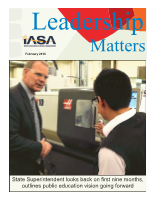
Junior Luis Miranda demonstrates a CNC Lathe in his
Advanced Manufacturing Technology class to State
Superintendent Dr. Tony Smith during a tour of District
211's STEM program at Palatine High School.