



 4 / 52


widespread adoption of marriage equality. Gays can now serve
in the military, too—certainly not something that was envi-
sioned in the early days of “Gay Lib.”
That the gay rights movement has lowered its sights to mar-
riage, military service, and freedom from overt discrimination,
there is disappointment on the part of those who remember the
original goals—and even some who weren’t born yet. Sure, we
can get married, live in the suburbs, and tend to our portfolios.
But the price of assimilation is that we’ve given up any hope of
changing society as a whole. Or so say the critics of today’s gay
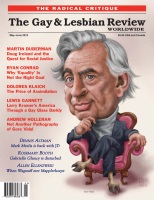
movement, some of whom are featured in this issue.
One such critic is Ryan Conrad, a young activist who’s in-
terviewed here. Conrad heads a group called Against Equality
whose argument is that “equality” isn’t meaningful in the con-
text of crushing
in
equality in society at large. One who remem-
bers the “liberation” era is Dolores Klaich, who ponders the cost
of success in various spheres of life. Martin Duberman, himself
a leftist historian, discusses the life and work of the late Doug
Ireland, who began his firebrand career in the ’60s and never
gave in to the lure of assimilation. Andrew Holleran reflects on
that old gadfly of American politics, Gore Vidal; while Lewis
Gannett considers another famous revisionist, Larry Kramer,
whose epic novel
The American People
takes on all of U.S. his-
tory but whose sharpest barbs over the years have been aimed at
the gay rights movement itself.
R
ICHARD
S
CHNEIDER
J
R
.
I
T WAS ALWAYS INEVITABLE
that the GLBT rights movement
would become more moderate over time. Such is the fate of
all civil rights movements if they’re successful, because free-
dom from discrimination by definition brings the oppressed mi-
nority closer in to the social fold, diminishing the magnitude of
its oppression. Also, as Max Weber showed, the trajectory of all
social enterprise is to grow more bureaucratic and risk-averse
over time, as witness the mainstream GLBT rights organizations
that occupy large suites in Washington, D.C.
There’s also the historical fact that the movement arose dur-
ing very unusual times. While its organizational model was the
Civil Rights Movement of the 1950s, gay liberation was very
much a creature of the ’60s and thus bore elements of New Left
politics, antiwar activism, and hippie culture. When it first ex-
ploded onto the scene after the Stonewall Riots—bolstered by
the Sexual Revolution that was already in full swing—the goal
was not just equal rights but sweeping social change: a radical
rethinking of marriage and the family, a whole new attitude to-
ward sexuality, a redefinition of gender roles.
Of course, it couldn’t last. Yet the collapse of these utopian
ideals was not a failure of gay liberation. Barely a decade after
Stonewall, the country had turned to Reagan, and the revolution
was over. The gay rights movement actually outlasted the New
Left, survived the AIDS epidemic (or was energized by it), and
went on to achieve some remarkable things, most recently the
Annual Pride Issue: “The Radical Critique”
FROM THE EDITOR
4
The Gay & Lesbian Review
/
WORLDWIDE
“Marsh shares his affection for Walt Whitman in this gentle, thoughtful
consideration of the poet’s relevance to 21st-century America.... Marsh
confesses his love for the legendary poet, and by the end of this insight-
ful homage, readers are likely to feel the same.”
—
Kirkus Reviews
“One of the most engaged and engaging books on Whitman that I’ve
read in many years.... Once every generation or so, we need a book like
this one to remind us why, in the twenty-first century, it is still so essen-
tial to keep Whitman close at hand.”
—Ed Folsom
,
University of Iowa;
editor,
Walt Whitman Quarterly Review
; co-director, Walt Whitman Archive
IN WALT
WE TRUST
how a queer socialist poet can save america from itself
by John Marsh
“Whitman’s radical journey is our radical
journey, and John Marsh captures the
very essence of Whitman, and America,
in this brilliant book.”
—
John Nichols
,
Washington correspondent for
The Nation
256 pages | $25 | hardcover
available from
MONTHLY REVIEW PRESS
www.monthlyreview.org800.670.9499
About
love, jealousy, bigotry,
and
courage
in a small Texas town as two men struggle
for their right to dignity, family, and love.
www. Amazon.com www.Barnes and Noble.com