


 8-9 / 16


7
6
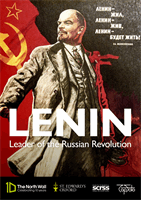
LENIN
– A LIFE IN POLITICS
AND REVOLUTION
1917: Year of Revolution
Lenin was in exile in Switzerland in early
1917 when political events in Russia
began to move rapidly in the direction
of significant political upheaval. The
February Revolution came after a series
of major defeats for the Russian armies
on the Eastern Front, which forced Tsar
Nicholas II to abdicate. He was replaced
by a Provisional Government, desiring
social democracy, under the leadership
of Aleksander Kerensky. It was only in
April, weeks after the first Revolution,
that Lenin managed to negotiate with
the Germans to allow him and other
Bolsheviks to travel in a sealed train back
to Russia. The Germans facilitated this
because they hoped that Lenin would
further destabilise Russia in WWI.
Lenin arrived to a great welcome from
the Bolsheviks at the Finland Station
and he immediately condemned the
Provisional Government. In the July
Days the Bolsheviks launched an
insurrection against the Provisional
Government. Kerensky was able to
defeat the attempted coup, and several
senior Bolsheviks were arrested, but
Lenin escaped to Finland. In August,
General Kornilov, the Commander-in-
Chief of the Russian Army, marched on
Petrograd and this forced Kerensky to
mobilise the Petrograd Soviet, including
the Bolsheviks, as the Red Army, to
defend the city. The coup failed to even
reach Petrograd, but the Bolsheviks
were now returned to the political
centre stage. Lenin returned to the
city in October and plotted revolution.
The Bolshevik coup started with the
battleship
Aurora
firing upon the Winter
Palace to signal the start of the Bolshevik
Revolution. The Revolution was largely
bloodless and the Bolsheviks stormed
the Winter Palace, which was only
guarded by cadets and women, almost
without resistance. The ministers of the
Provisional Government were seized
and a new government, the Council of
People’s Commissars, was declared. The
American socialist journalist, John Reed,
brilliantly captured events in his book
Ten Days That Shook the World
.
Lenin the Man
Ilyich Ulyanov was born to a wealthy
middle-class family of mixed ethnic
origins, including Jewish, Swedish and
German background, in Simbirsk. The
historian Robert Service describes him
as “a strange little boy”, opinionated
and self-centred. Ulyanov only
embraced revolutionary socialist
politics after his brother’s execution
in 1887 for conspiracy to assassinate
Tsar Alexander III. Later, Ulyanov was
expelled from Kazan Imperial University
for participating in protests against
the Tsar, Alexander. Moving to Saint
Petersburg in 1893, he became a senior
figure among the Marxists. In 1897,
Ulyanov was arrested and exiled to
Shushenskoye, Siberia, for three years,
where he married fellow revolutionary
Nadezhda Krupskaya. In these years
Ulyanov wrote prodigiously and in
1901 he began to use the pseudonym
‘Lenin’. After his exile, he moved to
Western Europe and, in 1903, he took
a key role in an ideological split in the
Marxists, leading the Bolshevik faction
against the more moderate Mensheviks.
Lenin then returned to Russia from
exile in Switzerland in 1917 to lead the
October Revolution. He then led the
new Bolshevik government through the
Civil War against the “White Russians”
and oversaw the formation of the
Soviet Union in 1922, all whist living a
famously austere lifestyle. Lenin also
expressed a view towards violence
that is, in many ways, shocking. He did
not relish violence, but he regarded
violence towards his enemies as
a necessary tool to be used when
needed. At the same time, he was also
a proponent of state terror and its
use to control the new state that he
was creating. Despite this, it is worth
remembering that Lenin genuinely
believed that everything he did was
for the proletariat and he envisioned a
long-term future in which there would
be no oppression. He died two years
after the establishment of the Soviet
Union in Gorki in 1924.
Barnabas Fletcher
Upper Sixth