


 14 / 44


ON THE
COVER
about six to seven years on a set of liners
where some aggregate producers are for-
tunate if they can get six weeks use from
their liners.
“From the primary crusher, everything
is stockpiled depending on the source,
whether it is limestone or dolomite,”he says.
Aggregate is sold from the primary
stockpiles and we feed the secondary pro-
cess plants from the other stockpiles.
“High grade dolomite is crushed and
screened in the secondary plant utilising HSI
crushers down to -1,0 mm. The same applies
for the limestone which goes through the
secondary limestone process plant where
we reduce it to two sizes: -1,0 mm which
goes to the glass industry, and 1,0-6,0 mm
which is fed to the fluid bed calciner kiln. We
draw off some ultrafines from the -1,0 mm
fraction with an air classifier to supply cli-
ents in the effluent treatment industry. The
limestone is fed to the kiln and calcined at
roughly 900
o
to convert the calcium carbon-
ate (CaCO
3
) to calcium oxide (CaO).
“Some of the calcium oxide is sold as
quick lime with the majority being hydrated.
It is reacted with water to produce a dry
white calcium hydroxide (Ca(OH)
2
) pow-
der. It is very alkaline and applications of
hydrated lime is in water treatment and
minerals processing such as copper, zinc,
gold and uranium, which require lime to
maintain pH levels. One of the main appli-
cations in South Africa is in the steel and
minerals processing industries, and that is
where we can’t and don’t want to compete
because of the distance from markets and
scale of operation.
“Therefore we are focusing on the white
lime market which is in the calcium hypo-
chlorite (Ca(CIO)
2
) sector as well as applica-
tions where low impurity levels in the lime is
a necessity. Our focus is thus on the import
replacement of lime,” Terblanche says,
adding that the company is working on a
new product line which still needs a few
changes, but which he believes will be very
successful. He is hopeful that these innova-
tions will enable further expansion leading
to the construction of a second kiln.
On themining side the overburden strip-
ping is outsourced and drilling and blasting
is carried out by Afrimat Contract Drilling.
Loading, hauling and crushing is done by
Cape Lime as is all internal transport.
The operation is utilising a fleet of
Mercedes 14 m
3
twinsteers. Terblanche
12
MODERN QUARRYING
July - August 2017
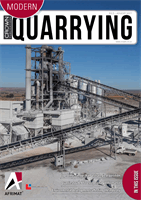
The Cape Lime operation in Vredendal.
The high grade limestone at Cape Lime is among the best of its kind in South Africa.