


 14 / 40


12
AFRICAN FUSION
March 2016
Cover story: H-ESC from Lincoln Electric
C
ladding is a fundamental process
in the Fabrication industry and is
applied across the whole spec-
trumof applications – from the nuclear,
oil and gas industries to petrochemicals
and steelmaking. Cladding is required
on the process side of high-pressure
critical process plant equipment (CPE)
to provide corrosion resistance against
severely corrosive service fluids or to
increasewear resistanceof a component
being subjected to heavy wear and tear
applications, such as continuous casting
rollers in steel mills.
While carbon-manganese steel
substrates, low alloy steels and other
materials provide strength and other
physical properties; cladding provides
the desired corrosion and wear resis-
tance. The result is extraordinary flex-
ibility and cost savings.
While most of the existing arc and
electro-slag welding processes can be
utilised for weld cladding, strip cladding
with submerged-arc and electro-slag
welding processes are the most attrac-
tive choices for applications that require
large surface area coverage due to their
substantially higher deposition and
surface area coverage rates.
Submerged-arc strip cladding
A new dimension
in strip cladding
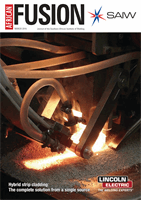
Hybrid electro-slag cladding (H-ESC) adds multiple metal-cored wires to
the molten pool as a third consumable. This enables surface chemistry to
be achieved in a single layer, even for Ni-625 alloys.
The Hybrid 3D Z5 automatic welding control and data logging system
ensures the pre-determined ratio of strip and wire feeding is maintained
during H-ESC.
Lincoln Electric company, through its global multi-arc welding systems specialist,
Uhrhan & Schwill Schweisstechnik, has developed a newhybrid electro-slag
strip cladding process (H-ESC) for significantly better deposition rates
and lower dilution levels on nickel-based and stainless steel cladding
applications.
(SASC) uses an arc that runs back and
forth at high speed along the strip.
The arc causes high penetration into
the base material, resulting in dilution
levels of approximately 20%. Typical
deposition rates are in the region of 12
to 14 kg/h for a 60 by 0.5 mm strip, but
this is limitedbecause higher deposition
rates can only be achieved by increasing
the current, which increases plate fusion
causing unacceptably high dilution.
Conventional electro-slag strip
cladding (ESC) is an arcless process that
uses a conductive flux that melts the
consumable via the Joule heating or
resistance heating principle. The current
passes through the molten slag and the
resulting resistance heating melts the
strip, depositing it asmoltenweldmetal
onto the base material. Lower dilution
levels (9 to 12%) are therefore achieved
at deposition rates of 22 to 28 kg/hour,
giving the process significant advan-
tages over SASC.
The new state-of-the-art hybrid
technique (H-ESC) from Lincoln Electric
is a variant of the ESC process. As well
as all of the features associated with
conventional electro-slag cladding,mul-
tiple hotmetal-coredwires are added to
the molten pool as a third consumable.
The addition
further cools
the weld pool – because of the heat
extracted to melt the hot wires (latent
heat of melting).
As a result, plate fusion can be
further reduced, typically enabling dilu-
tion levels for Ni-625 alloys of less than
5% Fe in a single layer. This has been a
long-held goal for fabricators of critical
process equipment in thepetrochemical
industry, a goal that is now achievable
without having to use an alloyed flux.
Using a custom-designed digital
weld control and data logging system,
this patent-pending high-speed tech-
nique can be used to accurately control
the dilution level to achieve the desired
cladding chemistry for a variety of appli-