


 37 / 68


April - May, 2017
|
35
D I R E C T O R ’ S N O T E | L Y R I C O P E R A O F C H I C A G O
From George Bernard Shaw’s play
Pygmalion
(1913) to the
musical comedy of Lerner and Loewe (1956), followed by
George Cukor’s film (1964) – have you found inspiration in each stage
of the success of
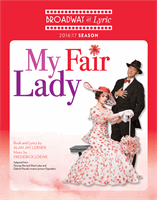
My Fair Lady
?
They all offer something, and that includes the text of Ovid that inspired
Shaw. In Ovid, Venus gives life to Galatea, the sculpture created by
Pygmalion, with which he falls in love. With Shaw, the story isn’t
completed by a romance. The playwright objected to the idea of an
adaptation, even more to a happy ending. The musical comedy premiered
six years after Shaw’s death and captivated the public. Its extraordinary
success (2,717 performances of the original production on Broadway and
2,281 in London) is obviously due to the delicious music of Frederick
Loewe and the extraordinary quality of the lyrics of Alan Jay Lerner.
The music follows the action, supports it, and enlivens it. The lyrics are
brilliant, light, witty, and full of spirit, but also pointed, rich in sense.
The work’s strength lies equally in its directness and sincerity, as well as
its sophistication.
My Fair Lady
isn’t just a fairy tale?
Beyond the grand, primary emotions, it has to do with how George
Bernard Shaw regarded the English society of his time – a profoundly
inegalitarian society in which people judged other people according to their
accent. Shaw anticipates that all of this will change. He is equally visionary
in his perception of the rights of women, describing precisely the way in
which women were regarded – that is, without respect. He makes himself
the champion of their emancipation.
The story is solidly anchored in English society, in the duality between
the working class with their Cockney speech and the snobbism of the upper
classes. Shaw sometimes amuses himself with this, but he doesn’t deal with
anything lightly. He never loses his critical sense, nor his concern to show
men as they are. So, in the scene in which Alfred Doolittle, Eliza’s father,
comes to see Henry Higgins to ask him for money – in fact, to sell him his
daughter – Doolittle explains very simply to Higgins (who is shocked by his
approach) that morality is a luxury that he, as a poor man, cannot afford.
Is the historic anchoring of the work a given that restricts you?
It’s very important. One can’t neglect the social and political side of this
work. The piece is supposed to take place at the dawn of the First World
War, in a frozen society. The only liberty that we’ve taken is an adjustment
of the period, a shift forward of fifteen years, to place the action at the
dawn of the Second World War. This doesn’t change the given: at that
time English society was even more frozen, even more unjust, and the
rituals were the same. Tis slight but important shift in period allowed us
the freedom to make the costumes more fluid, more modern to our eyes
– and equally importantly, to allow some color into the show. However,
this period is really the latest that one can situate the action – this world
of privilege will disappear forever after World War II. Indeed, today
one might go so far as to say you need to have a Cockney accent to be
considered of interest or importance in London!
The principal characters are well defined: Higgins is unsympathetic,
Colonel Pickering the most human, and Eliza the “poor sparrow” who
ravishes every heart.
These characters aren’t that simple. Their belonging to a particular social
class doesn’t determine who they are. What interests Shaw is the human
condition in its complexity. Higgins is a complex personality, with
monstrous egotism, but he has the honesty to recognize it. Even if he
belongs to the upper class, he is iconoclastic, mocks conventions, doesn’t
respect the rituals of attire, and is the despair of his mother when he shows
up at Ascot. He is eccentric in the English manner, which gives him a good
deal of charm. Colonel Pickering is much more traditional; he represents
the England of the Empire, the England of “fair play” and “good sport,”
which will not change but which will soon disappear. It must be said that
if he is less original than Higgins, he is also more human: he treats Eliza
with respect, just as he does Higgins’s mother.
As for Eliza, it’s a magnificent role, a dream for an actress, with a very
wide compass from the rough and noisy flower girl to the gracious lady of
high society, the queen of the ball. It’s a role that requires temperament.
Eliza has ambition, in the human sense of the word; she wants to make
something of her life, and she seizes the opportunity of the fortuitous
encounter with Higgins by the entrance of the Royal Opera House at
Covent Garden to shape her destiny. It is she who goes to see him to ask
for lessons in speech. She wants to progress socially, and it is she who hopes
to become – thanks to her mastery of the language – a florist in a shop. She
fights, she refuses to be only an object. She is Cinderella gifted with a real
personality, and her story joins the myths of other fairy tales.
Does the great popularity of
My Fair Lady
allow for any freedom
in the staging?
This work, which has been called the perfect musical comedy, doesn’t need
a director to change everything. My role is to put into place a coherent
and convincing vision in approaching the scenic challenges, the numerous
set changes, the frequent moves from one world to another, from speech
to sung text, from the working-class world to high society – and this can
happen very quickly at times. Certain scenes last five minutes, others more
than fifteen. One must find the proper rhythm to make the transitions
fluid and to maintain the magic of the big numbers and the famous scenes:
the market at Covent Garden, the horse race at Ascot, the embassy ball.
The whole piece takes place in London, and perhaps our vision of this great
city (before the terrible destruction of the Second World War) is rather
different from what has been seen in other productions: lighter, whiter
and more open. For this piece, teamwork is fundamental. One part of
the production’s attraction rests in the elegant and intelligent sets of Tim
Hatley, the other in the rich beauty and exciting elegance of the costumes
designed by Anthony Powell. Not to mention Lynne Page’s lovely and
witty choreography.
Is work on the language fundamental?
It is essential.
Pygmalion
is a play about the English language, about the
confrontation between ways of speaking during a specific period, with
importance in respect to the word. You need actors of great quality to do
justice to both the spoken and sung episodes, and to embody personalities
more complex than they might seem.
And the ending? A possible romance between Eliza and Higgins?
The ending needs special treatment. In our production, it’s a bit different
from what one usually shows onstage. We have tried to imagine what
Shaw – who opposed the idea of a romance between between Higgins
and Eliza – had in mind, and, being faithful to his spirit, imagine what a
possible happy ending could really signify for his Pygmalion and Galatea…
Translation: Roger Pines
Reprinted by permission of the Théâtre du Châtelet, Paris.
Singing the War Between the Classes
Robert Carsen, director of
My Fair Lady
, spoke with Geneviève Joublin in December 2010.
Here are excerpts from that conversation.