


 14 / 40


12
AFRICAN FUSION
March 2017
Cover story: Lincoln Electric training solutions
T
he Lincoln Electric Welding
School in Cleveland, Ohio is
the longest operating and most
comprehensive welding training facility
in the world. The school was initially set
up in 1917 and has trained more than
150 000 people in various welding tech-
nologies, techniques and associated
safety practices.
“At Lincoln Electric we understand
the importance of training. We have
established and equipped hundreds
of training schools around the world
and we are a global industry partner of
competitions such as WorldSkills Inter-
national,” says Lamotte.
Lincoln Electric has been the ex-
clusive provider of equipment, con-
sumables and fume extraction for the
WorldSkills competitions for the past
five years. “World Skills South Africawas
held in February this year in Durban to
identify SouthAfrica’s best youngwelder
to compete in the 2017WorldSkills Inter-
national competition in Abu Dhabi later
this year. Lincoln Electricwas the official
sponsor for the welding skill catagory,
as it will be in Abu Dhabi,” Lamotte tells
African Fusion
.
“No company in the world has more
experience in setting up supporting
welding schools than Lincoln Electric,”
continues Uys. His company, Airtrax,
designs training schools; installing the
safety infrastructure such as fume ex-
traction and deciding which processes
and machines will give young welders
the best chance of success.
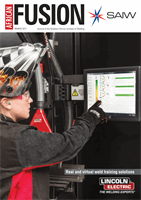
Following the proven success of the VRTEX® virtual training
solution, Lincoln Electric is launching its REALWELD® train-
ing systemintoSouthAfrica, amonitoringand live coaching system
designed to monitor skills during real welding.
African Fusion
talks
to Benoit Lamotte of Lincoln Electric and training school specialist,
Louis Uys of Airtrax.
Advanced training solutions:
skills and body positioning to the weld-
ing boothwhile reducingmaterial waste
associated with traditional training.
The combination of a realistic weld
pool and welding sound, and real-time
feedback with respect to the position,
speed and manipulation of the welding
torch provide a realistic, exciting and
hands-on training experience.
“There are now three different ver-
sions of the VRTEX system,” says Uys.
At the starting point of introducing
a student to welding is the VRTEX En-
gage™, which is a suitcase version of the
system. VRTEX Engage includes a touch
screen monitor, welding gun, tracking
device and awork surface, all contained
in a lightweight and portable carrying
case that can be taken to classrooms,
careers fairs or recruitment offices
anywhere.
This is a cost-effective tool designed
to expose or introduce students to
welding, without the need for a work-
shop, weldingmachines, metal and con-
Uys believes that welder training
should start in a classroom. “We be-
lieve it is best to start off on a welding
simulator. Our studies prove that if a
trainee starts learning about welding
in our simulated environment, the
chances of becoming a certi-
fied welder are much higher
and faster.”
Citing a trial conducted
at the Iowa State University
in the US, Lamotte says that
a group of 22 trainee weld-
ers was split into two. One
group began their training
the traditional way, with
a welding torch in
hand and an in-
structor teach-
ing them how
to manipulate a
real arc.
The other group started to learn
using Lincoln’s VRTEX virtual welding
solution. Only once torchmanipulation
skills had beenmastered, were trainees
allowed into the workshop to start real
welding. These 11 trainees spent 50%
of the training time on the simulator
with the other 50% being used in the
welding shop.
“The pass rate with respect to the
weldqualification testswas significantly
better in group that spent 50% of their
time on the VRTEX simulator,” Lamotte
reveals, adding: “although these people
did less real welding, they were better
welders at the end of the day.” The
VRTEX group proved 41.6% more suc-
cessful in achieving certification, in
spite of a 23% decrease in the overall
training time.
Lincoln’s VRTEX virtual reality weld-
ing system is a computer-based training
systemdesigned to supplement and en-
hance traditional welder training. These
systems allow students to practise their
welding technique in a simulated and
immersive environment, promoting
the efficient transfer of quality welding